Monday, March 14, 2011

Lent 2, Genesis - Blessing and Curse

Lent 2 - Genesis 12.1-4a


Blessing and Curse


“In you all the families of the earth shall be blessed.” (Gen 12.3)


“I will make of you a great nation.” As an advocate for human rights for Palestinians, these verses from Genesis stick in my gut. They represent families in East Jerusalem sitting on plastic chairs in the street, under a plastic tarp, evicted from their homes. This is what great nations do, isn’t it?—they rule!


My own country is also heir to these words. By most every measure, the United States is a “great nation.” And I am great, blessed beyond all my dreams, with health, wealth, security, and happiness. But grab the edge of a blessing, lift it up and turn it over and on the dark, wet underside you will find a curse. My country is a blessing, but it is also a curse...to its own poor and the poor of the world.


Given the choice, most of us would choose greatness. The question is—will our greatness be a blessing or a curse? Who is blessed by American’s greatness? Who is cursed by it?

For five years, Avital has lived in a house in East Jerusalem with her husband and two preschoolers. This is the Arab part of Jerusalem, on the Palestinian side of the Green LIne, the 1949 armistice line. Avital invited us into her living room and told us about her decision to move from Netanya to Jerusalem, a dream-come-true for her, to live within walking distance of the Old City. “This is our country,” she tells us. She says she lives here so that Jews can surround the Old City and protect their right to access.


She moved here because it is a diverse neighborhood. She looked forward to living with families from different backgrounds, but now she is just afraid of them—afraid to speak to the Palestinian families in her neighborhood because she sees them demonstrating against the evictions every week. She tells us that Palestinians are evicted bec

ause they do not pay their rent, that her house was “abandoned.” The Israeli courts have affirmed her views. “The demonstrators don’t want to hear us,” she says.


Her house is owned by an Jewish American, who is investing lots of money in real estate in East Jerusalem, where the Palestinian Authority has always planned to situate its capitol. He rents the house to Avital and her husband for a low rent, very affordable for these young Jewish families. Photo: Avital telling us her story.


Avital told us part of the story. Nasser Ghawi told us another. His family is one of the families evicted from their home in East Jerusalem. The Ghawi family was given their home by the UN in the1950s, they had lived since the 1950s, as restitution for the home they lost in 1948 when Jewish militias forced them from

one of the Arab villages Israel was clearing out to create their new Jewish state (Israeli historian Ilan Pappe documents Arab removals in his book, The Ethnic Cleansing of Palestine). Although they

have documents showing ownership, an Israeli court ordered their eviction. Photo shows Nasser Ghawi standing by a poster protesting his eviction.


What does it mean to be God’s chosen people? Is it a blessing or a curse? Is Israel chosen? Is the US chosen?


How can our greatness be a blessing to the families of the earth? By selling them M-16s and F-16 fighter planes? By refusing to apply international law to Israel? By giving Israel$3 billlion a year for security, so that their soldiers can evict Palestinian families from their homes?


How can Israel’s greatness be a blessing to the families of the earth?


Gracious God, through your servant Abraham, you have shown us your faithfulness. Help us to trust, like Abraham, that you will bless us. As we live into that trust, help us to live so that we are a blessing to the nations of the earth. Amen.

Friday, March 11, 2011

Lent 1, Matthew - Command these Stones

Matthew 4.1-11

‘If you are the son of God, command these stones to become loaves of bread.’ (Mat 4.3)

Stones……they are everywhere in the Middle East. They form the roads and mark the paths of the goats on the hillside; they get stuck in your sandals. The stones are the architecture of the buildings—gleaming white in the sun. The Romans made roads from these stones that tourists walk on two thousand years later when they visit the Antonia Fortress in Jerusalem or the ruins of Sephoris near Nazareth.

The tempter stooped, scooped up some of these stones and challenged Jesus….”command these stones to become loaves of bread.” Sounds good—people are hungry and need our help. Jesus himself made miracle bread.

We are always most tempted by our own best intentions.

Twenty-seven Palestinian children were shot in the past year while they were gathering stones—gravel, building materials—or helping their families farm the area on the north end of the Gaza Strip, near its border with Israel. Defense for Children International reports on the injuries and deaths caused by Israel’s ongoing security measures.

In February, Mustafa, 17, Nashat, 16, and Mohammad, 15, were each shot in the leg while they were gathering gravel or watching others working on Palestinian land. Israelis still do not allow enough building materials through their checkpoints, so there is a market for gravel to make the cement to rebuild houses destroyed in Operation Cast Lead (January, 2009). Gathering the gravel is a good way to make some money to buy bread for your family. Until you are shot.

Awad, Abdullah, Said, Hasan, Ibrahim, Mohammad M, Arafat, Hameed, Mohammad S, Ahmad, Shamekh, Belal, Rasmi, Nu’man, Khaled, Mahmoud, Yahia, Mokhles, Suhaib, Fadi, Rami, Mahmoud S, Hatem, Ismail…..shot in the right leg, left leg, right elbow, the head, knee, torso, left arm. They were gathering gravel, grazing goats, collecting wood. They are 15-16-17 years old and they were helping their families survive. Children can earn $8-14 a day collecting building supplies from destroyed buildings close to Israel’s border. They were all working 30-800 meters inside the border fence. See photos of the boys and stories about each one

We could dismiss these injuries….lucky they weren’t killed…..they should have been more careful….everyone knows it’s dangerous to be too close to the border.

But we cannot dismiss our role in these shootings. It is our tax dollars that pay for this Israeli security, $3 billion every year. We pay for the weapons that shoot these children; we supply the bullets and the tear gas canisters that break up demonstrations against the land confiscations. It seemed like such a good idea to use our tax dollars to protect people from suicide bombers. But Abdullah, Mustafa, Awad and the rest of these young men are not suicide bombers; they are not the ones throwing rockets into Israel’s southern towns. And they are suffering. Every evening their mothers await their return, wondering who will be shot today. Photo: Gaza farmers loading their cart in 2009, near northern border with Israel - demolished farmhouse in background.

Gracious God, you led your people through the wilderness, through the rocky desert where Israelis and Palestinians are struggling and suffering. As you gave Moses your commandments, show us your will today and give us courage to worship you in the manner you desire…loosing the bonds of injustice, sharing bread with the hungry, bringing the homeless poor into our homes. Amen.

Thursday, March 10, 2011

Lent 1, Genesis - Tilling and Keeping

Lent 1-Genesis
Genesis 2.15-17; 3.1-7

Dear God,
It’s me, Eve. Remember?

It sounded like such a good idea, especially when the snake put it the way he did. Knowledge is a good thing, right? What could be the harm? And the snake….he was so attractive and his words made me feel powerful. Tilling and keeping….it’s all so boring, and the snake was offering me something more—to really make something of my life.

But it hasn’t turned out so well, has it?—thinking I had the wisdom to rule the world has only brought us starvation, enslavement, pollution and war exploding all over the planet.

Look at what is happening in your part of the world today—it hasn’t turned out so good. Guns and tanks everywhere, bulldozers destroying people’s homes.

In Al-Walaja, near Bethlehem where your son was born, people are standing in front of the bulldozers building a 25-foot-high wall around their village. The Israeli government says the wall will protect the settlers who have built their town on Al-Walaja’s farmlands. And now the bulldozers are destroying more of their olive groves to make way for the wall. The soldiers are trying to keep the villagers away from the construction, throwing teargas grenades at the protesters, who are refusing to give up. All our knowledge is not working. Photo: Al-Walaja—Israeli soldiers tear-gas Sheering and arrest her.

That sweet-tasting and beautiful-looking fruit Adam and I ate has rotted and turned poisonous. All our knowledge has not made us happy; it’s just given us a false sense of our own power; and now we are ashamed. We build walls to protect ourselves and they end up imprisoning us; we make bigger weapons and they end up killing our children; we send our armies all over the world to keep us safe and we are in more danger now than ever.

Now we are trying to decide whether to help the rebels in Libya and all our knowledge will not end the suffering.

Looking back, I’m sorry I didn’t just stick with the job you gave us—to till and keep the garden, to serve you and protect what you created. It turns out all you wanted was our happiness—if we had only listened.

Maybe that’s why you gave us Lent.

Love,
Eve

Gracious God, you have given your creatures abundance beyond anything we could dream of. But we have not paid attention to your generous desires for our happiness and have followed our own desires for power instead. Accept our heartfelt remorse and turn our hearts to the tilling and keeping of your beautiful creation. Amen.

Wednesday, March 9, 2011

A Lenten Geography - an invitation

Although it has become a message for every age, Jesus’ ministry happened in a specific place and time. As I walked the streets of Jerusalem, sailed on the Sea of Galilee and traveled the winding road down to the Jordan or through the hill country, I kept remembering that Jesus walked the same dusty roads and climbed the same dry hills I was walking each day—the land between the Jordan River and the Mediterranean Sea—the land that the Romans called Judaea and later renamed Palestine. Today we call it Palestine or Israel or sometimes even Israel/Palestine, revealing our own confusion and ambivalence about this disputed territory.

In the time of Jesus, the land which was the Roman province of Iudaea or Judaea was the scene of war and violence, bloodshed, torture and displacement. The Roman occupation meant onerous taxes for the Judean peasants; when they objected, their protests were often put down violently, with all the protesters killed or crucified and entire towns burned to the ground. Finally the Roman Emperor Hadrian defeated the Jews for the last time in the third Jewish rebellion in 135 CE; by renaming the land Syria Palaestina (and renaming Jerusalem Aelia Capitolina) he hoped to wipe out all trace of the Jewish people and put an end to the Jewish rebellions. The Jews were even banished from Jerusalem and the surrounding area and Rome brought foreigners in to colonize the area.

When Jesus walked these roads, the land was under occupation—the Roman Emperor and his army, his governors and procurators controlled the land and the lives of everyone who lived on the land. The Judeans disputed Rome's control of their lives and their land. Today ownership of the land is once again disputed and the part of the land deemed Palestinian is again under armed occupation.

Beginning with the story of his birth, the gospel writers make us acutely aware of the role of the Roman Empire in the lives of even the most ordinary people in first century Palestine. In Luke’s account, the story of Jesus’ birth opens as Mary and Joseph make their way from Nazareth to Bethlehem for the mandatory counting—required by the Empire for all of the occupied people. The Empire wants to determine the value of that which it possesses. Matthew’s account, too, is specific about Jesus’ birthplace: “in Bethlehem of Judea,” and about the time: “In the time of King Herod” (Matt 2.1).

Even the preparation for Jesus’ birth was rooted in the land. Gabriel comes “to a city of Galillee named Nazareth” (Lk 1.26) to tell Mary of the impending birth. Mary travels the hills of Palestine, from Nazareth to “a city of Judah” (which places it near Jerusalem). So we are reminded that Jesus was born, not only in a specific place, but in a specific time, with a specific relationship to what was going on in the world. And so it is today. The land of Palestine/Israel is a specific geography and the story of the passion, of God coming to live among us, of God’s work in the world to bring about a new way of life for God’s creation, is ongoing.

Where do we meet God today?

Where is God at work among the people of Palestine and Judea today?

The stories of the “living stones,” the people of this holy land, tell us much about God’s work. Each time I visit the Holy Land, the people I meet beg me to tell their stories, with confidence that if the world knew what was happening in the land today, their lives would change and the occupation, the 60-year Nakba (catastrophe), would end. There is a growing movement among Jews within Israel that would end the occupation because of the way the system of checkpoints and walls and permits for Palestinians has damaged the humanity of the Jews themselves. Hear some of the stories as we reflect on the texts for the Sundays in Lent—stories of the “living stones” of the land of Palestine today—people working for justice and peace in this much-ravaged land today.
Back to the blog

Friday, March 4, 2011

Ash Wednesday, Isaiah - Shout Out!

Ash Wednesday
March 9, 2011
Isaiah 58.1-12

Shout out, do not hold back!
Lift up your voice like a trumpet!
Announce to my people their rebellion…
(Is. 58.1)

What is the worship God desires from us?

Is it the Bach cantata, or the praise band? The old familiar hymns, or some new ones?

Isaiah is very clear here: what God desires is not our “fasting.” God is not impressed when we wear “sackcloth and ashes.” God is not moved by our rituals. The fasting God desires?—“loose the bonds of injustice.”

When I hear these words of Isaiah, I see the demonstrators in Tahrir Square, as they shouted out an end to tyranny, an end to oppression, an end to the misery of the poor, who cannot afford to buy food for their families. They stood their ground, occupying the square, until their demands were heard. Mubarak stepped down—his ruthless and cruel suppression of dissent finally overcome by the sheer numbers and persistence of the demonstrators.

Like Isaiah, these demonstrators protest hypocrisy. Isaiah saw the hypocrisy of the people who worshipped God by wearing sackcloth and ashes, but did nothing to care for God’s people. The demonstrators shouted out the hypocrisy of a president who amassed a large fortune while the people were going hungry. They shouted out the hypocrisy of a United States that talks democracy and freedom, but provides $1.5b for “security,” which tortures and silences those who question the government.

Ironically, many of the demonstrators were inspired by President Obama’s speech in Cairo shortly after he became president, in June of 2009. They were listening when he called for democracy, and they took him seriously when he announced his commitment to “governments that reflect the will of the people.”

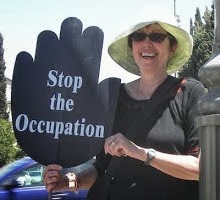
Each Friday afternoon in Sheikh Jarrah, as Jerusalem prepares for the Sabbath, a crowd gathers; drummers march through the streets, past the house that used to belong to the Gawi family. These demonstrators, primarily Jewish Israelis, call on the government of Israel to end its hypocrisy, to match its deeds with its words—they hold placards saying “Not in my Name!” and “Free East Jerusalem” and “End the Occupation!” This is their worship…..their Shabbat. Photo: Drummers leading protest in Sheikh Jarrah

On Fridays in Al-Walaja, Bil’in, Ni’lin, al-Ma’sara, Beit Ommar, Nabi Saleh, Bethlehem, and other villages throughout the West Bank, protesters leave the mosques after Friday prayers and march in non-violent action against the Israeli wall, still being built on Palestinian land. The wall continues to isolate these villages, cutting them off from families, schools, commerce and health care, forcing them to go through several checkpoints to get from one village in the West Bank to another.

Is not this the fast that I choose:
To loose the bonds of injustice,
To undo the thongs of the yoke,
To let the oppressed go free,
And to break every yoke?
(Is. 58.6)

God of all hope, your prophets called your people to actions of justice and reconciliation. Help those of us who live in the land of opportunity and freedom to break the yoke of oppression where we see it, to feed your hungry people and satisfy the needs of the afflicted, so that the world may see your light “break forth like the dawn.” Amen.