Wednesday, March 31, 2010

Maundy Thursday, "Thursday of the mandate"

John 13.1-17, 31b-35

I give you a new commandment, that you love one another. Just as I have loved you, you also should love one another.” (John 13.34)

Loving your friends—sounds idealistic, a bit simplistic, but not necessarily impossible. Until we read the part of the story tonight’s reading omits…..those fourteen verses in the comma, John 13.17-31b. And the verses that follow tonight’s reading—verses 36-38.

In the verses we don’t read on this night Jesus says, “one of you will betray me.” (13.21), and “before the cock crows, you will have denied me three times.” (13.38) Whoaa!! Now, that changes everything. While Jesus may have convinced Peter that it makes some sense for Jesus to show his love by washing the feet of his students, these verses in the “comma” reveal how ridiculous Jesus’ command really is. Love the ones who betray us? The ones who set a trap for us, to kill us? (read John 13.1-38)

Yet, Jesus is very precise: “as I have loved you,” knowing full well what will happen later that night when Judas identifies him for the Roman soldiers and the temple police. “Love one another,” even when the congregation includes betrayers and deserters. This is not merely one of the commandments of God; it is THE “new commandment” Jesus brings from God for those gathered at his table.

The Palestinians I have met know intimately what it means to be betrayed and deserted.

In“Lawrence of Arabia,” you may remember that British officer Lawrence gains the support of the Arab sheiks in the fight against the Turks by promising them autonomy. While the movie is not history, it reveals a very real promise made to the tribes living in the land between Egypt and Turkey—the lands which today are part of Jordan, the state of Israel and the Palestinian Authority (West Bank and Gaza). The people of the region, who had suffered under Ottoman occupation, were promised freedom in exchange for helping to defeat the Turks. The Arab leaders were betrayed by Britain when its Cabinet agreed to support “the establishment in Palestine of a national home for the Jewish people” (Balfour Declaration of 1917, from the appendix of A Palestinian Cry for Reconciliation, by Naim Stifan Ateek, Orbis Books, 2009).

While the movie is historical fiction, the promise of autonomy is very much a part of the real history of the Palestinian people. In The Olive Grove, (Saqi, 2009) Deborah Rohan writes the story of the Moghrabi family (who eventually emmigrated to Colorado). The grandfather, Kamel, was arrested by the Turks for joining with the British. His family’s story tells how the broken promise of Palestinian autonomy haunts him for the rest of his life and becomes an important part of the family story. In May, 1948, they are forced to flee for their lives, abandoning their home in Akka as the Zionist soldiers take over the town. Kamel Moghrabi died in Lebanon, heartbroken that his efforts to reclaim his home, his farmlands (the olive groves) or even the money he had in the bank, were futile. Bureaucratic regulations put in place by the newly forming State of Israel prevented Palestinians from claiming their property and money—declaring it “abandoned.”

Every Palestinian I have met has a similar story of betrayal—of abandonment by a world that watched more than 800,000 Palestinians fled their homes as the Zionists took over Arab towns following the withdrawal of the British troops from Palestine in 1948. The families all thought they would return to their homes after the fighting. Like Kamel Moghrabi, they believed that the world would not stand by while such injustices were committed. They were betrayed by the international community, which named the injustices in United Nations resolutions, but did nothing to help them reclaim their possessions.

But even in this 62nd year of their suffering, the Palestinians welcome visitors to their land—visitors like me from the very country that is still betraying them with $2.55B in military aid to Israel to support their occupation. Photo: Iptysam and her family welcome me into their home in Beit Jala.
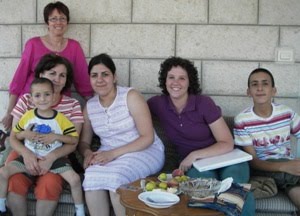
“Just as I have loved you, you also should love one another.” I have experienced this Christian love in the welcome I receive when I visit the Palestinians in Bethlehem—even the Muslims. A love that transcends the betrayal and the desertion they still experience—while US dollars buy more ammunition for the Israeli soldiers who arrest their sons marching in protest of the Wall.

How can this be? It is a mystery to me—like the resurrection that awaits at the end of this most holy week.

Gracious God, you command us to follow in your way of love. You sent your son to bring us your message of reconciliation and peace, knowing that your love would be returned with betrayal and desertion, even by those who called you teacher and friend. Give us courage to be agents of reconciliation today—to carry your love even to those places where we will be betrayed and deserted. Amen.

Sunday, March 28, 2010

Evening, Palm Sunday, 2010

Luke 19.28-40

“When he had come near Bethphage and Bethany, at the place called the Mount of Olives, he sent two of his disciples….” (Luke 19.29)

As we lifted palms in church and heard the familiar words of Jesus’ entry into Jerusalem and shouted “Hosanna!” we were reenacting, as many Christians have done through the centuries, the event that begins the holiest week in the Christian calendar. Each year, Christians from all over the world retrace Jesus’ steps, processing down the Mount of Olives and into the Old City of Jerusalem. Palestinian Christians from Bethlehem and the rest of the West Bank have participated in this procession for many years.

Even in Luke’s account, there are mixed reactions to Jesus and the adulation of the crowds. As they shout for joy and throw their cloaks on the path to welcome him, “some of the Pharisees” are worried and warn that this public acclamation should stop.

Not much has changed in the past two thousand years. The procession of palms in Jerusalem—Christians parading through the streets, praising God and marking this holiest of weeks, are still seen as a threat.

Although pilgrims from Ireland, the Philippines and Utah walked in the Jerusalem procession today, most Palestinians from the West Bank were denied entry into Jerusalem. In spite of the efforts of Palestinian church leaders who have been working with Israeli officials for weeks, no permits were given for their congregations to travel to Jerusalem, and Palestinians do not travel anywhere without permits. The five or so miles from Bethlehem to Jerusalem have become a divide that cannot be breached.

In Bethlehem today about 150 Palestinian Christians, with their Israeli and Muslim supporters, (along with two donkeys and a horse) did manage to get past the checkpoint. But they were quickly stopped by soldiers who piled out of their jeeps—beating and arresting the marchers. Eleven Palestinians were arrested at the main tourist checkpoint between Bethlehem and Jerusalem, the place our tour buses go through when we visit. (See photo with the palms and the soldiers arresting one of the marchers.) Four Israeli peace activists who were also detained were later released by the Israeli soldiers. See more photos: http://www.flickr.com/photos/activestills/ Read the story from Ma’an news agency: http://www.maannews.net/eng/ViewDetails.aspx?ID=272253 ; more details from Dr. Mazin Qumsiyeh’s blog: http://www.qumsiyeh.org/rightsblog2010/

Other Palestinians did manage to celebrate Palm Sunday at the Church of the Nativity in Bethlehem. And others walked with palms in the village of Al-Zababdeh near the West Bank town of Jenin (see AP wire photo at top).

Even Jesus would not have been able to walk today from Bethany to Jerusalem. The Israeli security wall cuts off the main road, between Jericho and Jerusalem, the road that goes through Bethany. (photo shows where the wall blocks the Jericho road).

Today we marked Palm Sunday, not only with readings and reenactments of the procession, but also with the reading of the story of Jesus’ passion—the suffering he endured at the hands of the Roman empire, his arrest, the beating, the insults of the soldiers……….

Gracious God, you sent your son to show us your way of liberation and peace. Help us, who call ourselves by his name, to be messengers of peace and reconciliation in your world today. Help us break down the walls that divide us—to find one small thing we can do to bring reconciliation to the places where we live and work. Amen.

Wednesday, March 24, 2010

Lent 5, Gospel of John

John 12.1-8

Bethany is one of the Arab villages on the outskirts of East Jerusalem in the West Bank. The Arabic name is Al-Azariya (pronounce it quickly and you can hear then name of its namesake, from our story today—Lazareth). Its name comes from the Greek “Lazarion,” or “place of Lazarus.” Some mosaic pavement, the remains of a fourth century Byzantine church, can be seen there today outside the Franciscan Church of Saint Lazarus. The journal of Egeria tells us that pilgrims have been coming here since at least 384. She writes, “so many people have collected that they fill not only the Lazarium itself, but all the fields around.”

Today’s pilgrims drive to Al-Azariya in tour buses and make the short but difficult walk down the uneven steps to the Tomb of Lazarus, a small burial chamber with an anteroom. They might also visit the two churches and the mosque that mark this site. Muslims also venerate the raising of Lazarus, and by the fourteenth century the church built over his tomb had become a mosque.

Jesus came here for supper with his good friends shortly before his journey into Jerusalem, much like we gathered around these verses of John’s gospel the week before we celebrate that journey with hosannas and palms.

Before Israel’s security wall was built, Bethany was a stop on the main road between Jericho and Jerusalem. As you can see on the map, today it is isolated from neighboring Arab communities by the security wall, which snakes its way through East Jerusalem, carving out an easy passage between West Jerusalem and the Israeli settlements built in the West Bank.

On the map, the name for Bethany is spelled Al-Eizariya. The green line is the unofficial border between Israel and the West Bank; Israel’s security barrier is shown by the red and purple lines. Brown areas are Arab towns and lands.blue areas are Israeli settlements and lands claimed by them. Click on the map to see it larger.

This is why so many Arab towns have been protesting the building of the wall in the past couple of weeks—the wall has carved up their communities, dividing farmers from their fields, families from their grandparents; cutting off commerce between Jericho, these Arab villages and Jerusalem. Jericho is east of Bethany—off the map to the right.

Last week in Beit Jala, protesters marched with banners of Rachel Corrie, a young woman from California who died seven years ago on March 21, as she stood in front of a bulldozer, hoping to prevent it from destroying the home of her friends in Gaza. Beit Jala is south of Al-Azariya on the map.

They also marched in Al-Ma’sara (at the bottom of the map, just south of Bethlehem), where Omar Alaaeddin (see photo), a 25 year-old community organizer lives. This week he spent six days in Israeli six different Israeli prisons before being released on bond, without charges. During this time he was beaten and interrogated. One of the soldiers told him "do you think the international solidarity will protect you?" You can read his story and see pictures of his injuries online: http://www.flickr.com/photos/activestills/ and http://www.imemc.org/index.php?obj_id=53&story_id=58264

In the coming Holy Week as we contemplate the suffering of Jesus, and his death at the hands of the Roman Empire and the church officials who chose to cooperate with that system, I will be remembering the suffering of those today who organize for justice and peace, those who are punished, beaten and bruised, for their protest against the injustices they suffer every day. I will also remember the members of the Lutheran congregations in Beit Sahour and the Bethlehem region who will be gathering around the same stories and remembering their own suffering and losses—the family members imprisoned, the businesses ruined, the olive groves on the other side of the wall, the family members in far-away countries who have left for a safer, more peaceful life. I will also be thinking of their faithful witness, as they speak out for reconciliation and peace in their weekly non-violent protests.

O God, you have given us life abundant and, in Mary’s anointing adoration, you have shown us your way of faithful discipleship. Embolden us to anoint the feet of those for whom suffering and death is a daily threat. Help us become your prophets of peace and reconciliation, standing against the forces that use terror and intimidation to silence those who proclaim justice and freedom. Amen.

Monday, March 22, 2010

Lent 5, Isaiah

Isaiah 43.16-21

“I am about to do a new thing;
Now it springs forth, do you not perceive it?” (Isaiah 43.19)

This week once again we heard prophetic words proclaimed to a people in exile—they have been forced from their homes and marched across the wilderness to a strange land; they have been uprooted from their homeland. The Israelites had been conquered by Nebuchadnezzar and removed from their homes in Judea. Far from all that is familiar, cut off from the temple which has been the center of their faith, they even feel cut off from God because they believed that God dwells in the ark in the center of the temple. They despair.

But the prophet has a message from God—God will do a NEW THING! “Do not remember the former things….I am about to do a new thing…..I will make a way in the wilderness and rivers in the desert.” God announces to a people who have lost everything—their homes, their lands, even those who feel estranged from their God—that all will be restored.

This is the promise that Palestinian Christians cling to; it is what they hear when they read scripture…..God’s promise that all will be made new, that all will be restored. Their suffering is not the end of the story.

Their hope is not based on hopeful signs from US, Israeli and Palestinian leaders on the nightly news. Their hope springs from good news like this from the prophet Isaiah.

This week I’ve listened to the tally of fatalities, as Palestinians march in protest of the seizure of their lands and Israeli actions limiting access to their farms and crops. They have also been marching in memory of Rachel Corrie, who was killed in Gaza seven years ago, run over by the bulldozer she tried to stop, hoping to prevent the destruction of another Palestinian home. These non-violent protest marches have been met by Israeli soldiers, tear gas canisters and rubber bullets, and, apparently, even live ammunition.

Doctors have provided x-rays that show live ammunition in the skull of nineteen-year-old Ousayab Qadous who died over the weekend in a demonstration in his village of Iraq Burin, near Nablus. http://palsolidarity.org/2010/03/11855. Following midday prayers on Saturday, the villagers were marching to protest the restrictions that prevented them from accessing their lands beneath the nearby Jewish-only Israeli settlement of Har Brakha. The marchers carried no weapons.

Similar events took place this weekend in other areas of the West Bank and Gaza, and Israeli security forces, deeming the marches to be “an existential threat” to Israel, arrived in the village with tear gas and rubber bullets http://palsolidarity.org/2010/03/11724. This is in the West Bank, on land that most of the world believes will someday become a state for Palestine. http://www.cnn.com/2010/WORLD/meast/03/21/israel.clashes/index.html

This weekend four, Palestinian youths have been killed in these incidents. And Palestinian militants fired a rocket that killed a Thai farmworker in a greenhouse in an Israeli agricultural community just north of Gaza on Thursday. Israel retaliated with airstrikes on Gaza that killed twelve.

To see how Palestinians are resisting the Israeli security wall, read a story and watch video of the weekly protests in Bi'lin in the West Bank: http://english.aljazeera.net/news/middleeast/2010/02/2010219142048591226.html.

Even the news that peace talks will soon start again does not give hope to people yearning for peace in their communities in Israel and Palestine. It is God’s promises that bring hope into communities like the ones Isaiah addresses.

You may note that the verbs in this passage from Isaiah are in the present and future tenses. Yes, God has saved God’s own people in the past, but this God of past miracles is also a God of a future we cannot imagine….a future of liberation and homecoming and refreshing waters in the desert. A God who can make what seems impossible a reality.

O God of liberation and new life, you have shown us your ways—of restoration, reconciliation and homecoming. Help us to follow where you lead. Give us courage to do our part to make the world a reflection of your good creation; strengthen us for your work to bring home the captives and bring refreshing waters of hope and well-being to parched, inhospitable lands. Amen.

Wednesday, March 17, 2010

Lent 4 - Gospel of Luke

Luke 15.1-3, 11b-32

The much-loved story of the Prodigal Son has inspired literature and art for two thousand years. We love to read about our God, so generous that nothing—not even total rejection of God and all the ways God would have us live—can cut us off from God’s unfailing love and mercy. No matter how far we stray from what God has intended for us, God will always welcome us back. All we need to do is return, turn toward God (“turning” is the definition of repentance); the door is always open. It’s interesting that the prodigal son had not reformed his life; he had not gotten his life together. He returned at the lowest moment, when he had lost everything. And this darkest moment is precisely when God welcomed him back with a lavish party, an extravagantly abundant celebration.

How different this notion of God is from the God who punishes evildoers by rewarding suicide bombers with a special place of honor in heaven; or the God who has promised all of the land, from the Euphrates to the sea, to descendants of the Israelites who practice one particular form of religion. How large and grand God seems in the story of the Prodigal Son; how tiny the God of the young man who walked into the Park Hotel in Netanya and killed 30 people with his suitcase-full of bombs, or the settler attacking schoolchildren on their way to school in the Hebron hills…..or the God who smiles upon American hegemony in the world, for that matter.

The signers of the Kairos Palestine document know a very large, generous, abundant God. The God of this document, “A Moment of Truth, a Word of Faith, Hope and Love from the Heart of Palestinian Suffering” is the prodigal God of our story today. Palestinian Christian leaders of thirteen denominations issued their call to the world in this document on December 15, 2009. It calls upon the international community and, in particular, the church community, to recognize their complicity in the occupation of Palestine and to take action and stand against this occupation that is causing so much suffering and despair.

Photo: signers of Kairos Palestine, Lutheran Bishop Mounib Younan, second from left

Like the South African Kairos Document issued by church leaders in 1985, the Palestinian church leaders hope that this document will begin discussion in churches around the world, encouraging them to talk about the injustice of the 43-year occupation of Palestine by Israel. The document calls the military occupation of their land a sin and defines true Christian theology as “a theology of love and solidarity with the oppressed, a call to justice and equality among peoples.”

The document begins with a list of ways that the occupation is making life unlivable for Palestinians and discusses the ways Israel’s actions violate international law. Proclaiming, “The land has a universal mission,” the document sets forth the theological and biblical understandings that shaped their statement. It identifies signs of hope and proclaims a prophetic mission for the church, “to speak the Word of God courageously, honestly and lovingly in the local context and in the midst of daily events.” Finally, it looks to the future with faith and hope.

Do we believe we are created in the image of God, or do we imagine a God created in our own image? How is God looking at the lives of Palestinians and Israelis, two peoples in one land, suffering the effects of sixty years of war and terror? What is God doing there today, and what would God have us do?

These church leaders invite us, “Come and see.” They promise to welcome us as pilgrims. They invite us to “know the facts and the people of this land, Palestinians and Israelis alike,” and “to see the face of God in each one of God’s creatures.”

And they look to the future: “In the absence of all hope, we cry out our cry of hope. We believe in God, good and just. We believe that God’s goodness will finally triumph over the evil of hate and of death that still persist in our land. We will see here "a new land" and "a new human being", capable of rising up in the spirit to love each one of his or her brothers and sisters.”

AMEN!

Read about the document: http://www.aaper.org/site/apps/nlnet/content2.aspx?c=quIXL8MPJpE&b=5492575&content_id=%7bCE92264D-510D-419B-9524-93966890E472%7d¬oc=1
View the document itself: http://www.kairospalestine.ps/sites/default/Documents/English.pdf

O God, you welcome us home with a love so much greater than anything we can imagine. We have sinned against heaven and before you. We are no longer worthy to be called your sons and daughters. Yet you throw open doors of exclusivity and shame, and you welcome ALL who enter, without judgment or conditions. Help us, who have been created in your image, to follow your example of extravagant love. By your generous welcome, break down our barriers of fear and shatter our so-carefully-guarded opinions. Give us courage to use our own prophetic voices in your work of reconciling the world. Amen.

If you would like to accept these Christian leaders’ invitation to “come and see,” think about making your own pilgrimage to the Holy Land. There are many opportunities, and we have a group going from the Rocky Mountain Synod. Check it out: http://www.pilgrimageholyland.blogspot.com/