Sunday, April 24, 2011

Easter, John - New Life from the Tomb

John 20.1-18
“I have seen the Lord.” (Jn 20.18)

Mary shows us that the miracle of Jesus’ resurrection is not the end of the story. Jesus’ terrible death and then the empty tomb, which seemed liked a tragedy, is transformed into a new beginning in her life...and ours.

Just as Jesus commanded his followers at their passover meal, “do this in remembrance of me,” we are also charged to remember Jesus’ ministry by following him—his life-giving miracles of healing and liberation show us to our own everyday acts of mercy and compassion. By our own small acts of healing, teaching, feeding the hungry, we follow our teacher.
In Jesus’ death and resurrection, we see what it means to rely on God’s spirit, to do what we cannot do on our own. In a world seemingly bereft of hope, we, like Mary, have witnessed God’s amazing power for life.

In Palestine today, even under the brutality of Israeli occupation, there are many signs of resurrection, places where, against all human expectation, new life is emerging.....God is still, today, bringing new life out of the tomb of death and destruction and hopelessness.

This new life can be seen in Bethlehem and Ramallah and Gaza, where the children of the occupation are being given the tools for their liberation—education, pride in their heritage, self-confidence to stand up for their human rights.

New life is emerging in Israel, out of the tomb of militarism, fear and hatred, when Israeli young people meet Palestinians in organizations like Sulha and when Machsom Watch grandmothers stand up for Palestinians at the checkpoints. New life is emerging where IDF soldiers question what they have done in the name of security and they refuse to serve in the occupied territory of the West Bank and Gaza (Breaking the Silence and the Shimistim).

Once glimpsed, the hope of resurrection cannot be quashed. We have seen hopes for new life race across northern Africa and spread throughout the Middle East, as people take to the streets, throwing their bodies in the line of fire.

Even in Denver, I see signs of new life for Palestinians. More and more people are learning about what has really been happening in Israel and Palestine. And more people are protesting Israel’s brutality and its disregard of international law and human rights.

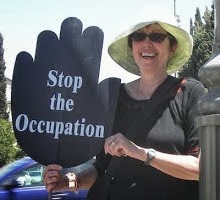
Watch some Alleliuia! action in Denver: http://www.youtube.com/watch?v=hWmfp1KEIOo. These protesters are challenging TIAA-CREF to live up to its motto, “Financial services for the greater good,” and pull their investments out of companies that support Israel’s occupation and the building of the apartheid wall. (If you squint, you can see me in my bright green jacket holding the yellow sign “End the Occupation”).

Whether you have investments with TIAA-CREF or not, take action on Jewish Voice for Peace’s new website: www.wedivest.org

Friday, April 22, 2011

Good Friday, Psalm 22

My God, my God, why have you forsaken me?
Why are you so far from helping me,
From the words of my groaning?

During the month of March, as we have been making our Lenten pilgrimage, 15 Palestinians were killed by Israel, including five children. As reported by the Palestine News Network, another 90 Palestinians, including 22 children, were wounded.

O my God, I cry by day, but you do not answer;
And by night, but find no rest.

Israeli troops arrested 270 Palestinians, including 20 international solidarity workers, who travel to Israel and Palestine to stand with the Palestinians in non-violent protest of continuing land confiscations and human rights abuses.

Yet you are holy, enthroned on the praises of Israel.
In you our ancestors trusted, and you delivered them.

“Israelis Don’t Want to Be Occupiers Either”—it’s not a message we often hear in the US. The words of Prime Ministers and Foreign Ministers usually drown out the voices of ordinary Israelis who see how militarization is corrupting the soul of their country. But these were the words of an Israeli peace activist, Gershon Baskin, as he reflected on the liberation movement sweeping across northern Africa toward the Middle East.

Baskin founded the Israel/Palestine Center for Research and Information (IPCRI), headquartered in Jerusalem. This organization brings Israelis and Palestinians together for weekly meetings to hear speakers and learn about one another to equip grassroots leaders who are knowledgeable and creative.

But I am a worm, and not human;
Scorned by others, and despised by the people.

Photo is from an exhibit, "Christ in the Palestinian Context"


After five members of a settler family were murdered in Itamar, near Nablus, Israeli authorities approved plans to build an additional 400 homes for the settlers. Itamar is an illegal settlement in the West Bank, wedged between Palestinian towns, villages and the refugee camps where Palestinians fled from the soldiers in 1948 and 1967. Itamar has taken land from these Palestinians to build their sprawling settlement, destroying olive groves and other agricultural land. Settlers from Itamar attack Palestinians, beating, occasionally torturing, and sometimes murdering Palestinians of all ages; they burn Palestinian crops, and hack down their groves of olive trees, the livelihood of many Palestinian villagers. Hundreds of these trees, have been destroyed by rampaging Israeli settlers. (http://www.ifamericansknew.org/media/itamar.html)

Yet it was you who took me from the womb;
You kept me safe on my mother’s breast.

Many Jews in Israel and in the US oppose Israel’s policies and are working to end the occupation. Jewish Voice for Peace has mounted a campaign supporting a shareholder resolution to request TIAA-CREF to engage with corporations in its portfolio, such as Caterpillar, Veolia, and Elbit, that operate on the West Bank and East Jerusalem, with the goal of ending all practices by which they profit from the Israeli occupation.

Do not be far from me,
For trouble is near
And there is no one to help.

In March, Israeli authorities demolished 70 Palestinian homes and other buildings, including a mosque.

For dogs are all around me;
a company of evildoers encircles me.

From Defense for Children International (DCI): On 8 March 2011, a 15-year-old boy from Beit Ummar village, West Bank, is arrested by Israeli soldiers from his family home at 1:00 am: Hands tied tightly behind his back with a single plastic tie - made to walk for an hour to the settlement of Karmi Zur - soldiers kicked him in the legs along the way - on arrival at the settlement he was made to sit on the ground for an hour in the cold and reports being slapped and punched - after an hour he was pushed into a military vehicle and transferred to the settlement of Gush Etzion for interrogation - interrogated by two men - "Sharif" and "Dawoud" - shouted at and confessed because he was 'scared' - signed a document written in Hebrew - taken outside and waited until 7:00 pm before being transferred to Ofer Prison - hands were tied so tightly behind his back that he began to scream in pain and they became swollen…

But you, O Lord, do not be far away!
O my help, come quickly to my aid!
Deliver my soul from the sword,
My life from the power of the dog!
Save me from the mouth of the lion!

Wednesday, April 20, 2011

Holy Week - Good Friday

Psalm 22

Do not be far from me,
For trouble is near
And there is no one to help.
(Ps 22.11)

Sixty-three years ago this month, the Palestinian village of Deir Yassin was the scene of a massacre by Jewish paramilitaries. It was April 9, 1948, just before Israel declared its independence on May 15. There have been many accounts of what happened that day—for many years Israelis denied that a massacre had taken place, but in recent years, as government documents were made available, it has become clear that the Irgun and the Lehi Zionist paramilitary groups, fanatical offshoots of the Hagannah, were responsible for the killing of more than 100 villagers, including women and children.

Dr. Masin Qumsiyeh, who spoke in Denver I March, wrote this poem on the anniversary of the Dei Yassin massacre, as he returned home from his US visit: http://desertpeace.wordpress.com/2011/04/09/a-poem-for-juliano/

Deir Yassin to Gaza
by Mazin Qumsiyeh, written in honor of Juliano Mer Khamis, who was killed in Jenin April 4. Learn more about him on my April 8 blog post.

My kind old mother laments
Decades of memory that transcends
Fake Gods and fake peace offers
who bless nichsayon and slaughter
our eyes fail to see or just lament
blood of a child licked off a pavement
By stray thirsty cats
with more morals than army brats
Our ears fail to hear
voice of Dr. Izzeldinne echoes
"I shall not hate" his anguished cries
After three beautiful daughters
With a tank shell and in a niece in a slaughters
Our noses fail to smell
The whiff of death mixed with gun powder
Or the vomit of our tortured
Our hearts fail to feel
the punctured womb by the old home
the severed girl's head by the mosque dome
Mutilated,
dismembered,
disconnected
Our fingers fail to touch
an anguished young mother
Looking for a child
Jews, Christian, Muslims wail
The lost humanity to no avail
the generals must have their joy
to test their newest toy
in Gaza white phosphorous back in use yesterday
impunity from war crimes thanks to the US of A
billionaires must make more dollars
zealots must sacrifice children at altars
Gabriel can stay a knife but not drones
And hate can murder a thousand Julianos
While the apathetic multitude watch TV
Obliviously focused on their shopping spree
Bypassing love and responsibility
Chasing gadgets, hate, and vanity
Next news bulletin.... get the experience
Next anniversary..awaken the conscience?

Poem also published by Palestine News Network:
http://english.pnn.ps/index.php?option=com_content&task=view&id=9865&Itemid=


[You can read a detailed and well-documented description of what is believed to have happened at Deir Yassin on Wikipedia: http://en.wikipedia.org/wiki/Deir_Yassin_massacre with pictures. Ilan Pappe writes about it in his book, The Ethnic Cleansing of Palestine.]

Monday, April 18, 2011

Holy Week - the Passover Seder

Exodus 12.1-4 [5-10] 11-14

Tonight, Monday of Holy Week is the first night of the Jewish Passover, a week of commemoration of the Exodus of the Israelites from Egypt. It is a time for reflection on a miracle—when God enlisted Moses’ help to plead for the freedom of the Israelite slaves and sent ten plagues to persuade Pharaoh to let them go. The tenth plague was the slaughter of the firstborn in every Egyptian household. God instructed the Israelites to mark their doorposts with the blood of a lamb so that the angel of death would “pass over” their homes. They were also instructed to prepare to flee their captivity in Egypt. Indeed, they left their homes in such a hurry that they had to grab their bread before it had risen. In remembrance of their hasty flight to freedom, Jews do not eat any leavened bread during Passover. Hence the plentiful supplies of matzo in the supermarket lately!


Passover, along with Shavuot and Sukkot, is one of the three pilgrimage festivals, when Jews were required to be present at the temple in Jerusalem. Holy Week is also a week of remembrance—when Jesus and his disciples, all good Jews, traveled to Jerusalem for the Passover was arrested, tried and killed.


God’s instructions to Moses and Aaron for observing Passover are the first lesson we read on Maundy Thursday because Jesus’ last meal with his disciples was the Passover meal.


Tonight, Monday in our Holy Week, Jews all over the world will be sharing a special meal, the Passover Seder. Jewish Voice for Peace offers this seder as a way to reflect on the Jewish exodus through the experience of the Palestinians who have been forced to pay the price for the existence of the State of Israel.


As Rabbi Alissa Wise of Jewish Voice for Peace explains, “This Haggadah takes our responsibility to be part of the ongoing evolution of Jewish culture and ritual seriously, by re-imagining and re-creating rituals to speak to our highest ethical values and political lives and commitments. You will find in this Haggadah, inspired by the tradition: olives on the seder plate, ten plagues of the Israeli occupation, four cups of wine dedicated to education, solidarity, the BDS movement, and community, and feminine and non-gendered blessing formulations.”


Or click here for the Jewish Voice for Peace Haggadah


Prayer: Even if you don’t read the whole Haggadah, please use the prayer of repentance, Nakba Dayenu, on page 15.


[Passover news from Palestine: Israel’s military is preparing for the Passover by announcing a "general closure" of the West Bank which will last for ten days. The closure will prevent Palestinians with work permits, from entering Israel and Jerusalem until 11:50 p.m. on 26 April. An exception is the few Palestinians who were granted permits to visit the holy sites in Holy Week (story, “Jewish Freedom Holiday Restricts Palestinians,” Ma’an News). Israel is also closing entrances to Gaza during Passover (see story, Ma’an News). Read Maria Khoury’s article about Christian access to Jerusalem in Palestine Network News. Dr. Khoury was in Denver in February and spoke at a Sabeel program.]

Friday, April 15, 2011

Lent 6, Palm Sunday, Matthew 27

Palm Sunday, Matthew Matthew 27.11-54

Now, THIS is a god Palestinians can identify with! This god, on trial before Pilate, convicted by the mob, spit upon, mocked, taunted with the vile-tasting wine, totally abandoned as he hung there dying—When Christians in Bethlehem read this story, they know what Jesus is facing. They have been there, arrested by Pilate’s soldiers, waiting in Pilate’s prison and standing in his courtroom.

They, too, have been betrayed by their leaders—their own leaders and their military rulers, the Israelis. They have sat forgotten in Israeli jails, where they have also been beaten—young and old alike. They have been mocked at checkpoints, taunted by soldiers who make them lift their shirts. They have suffered the indignity of a pat-down every time they want to leave their town. They have stood impotent as the soldiers beat their children. They have stood for hours in the hot sun, at the whim of a 19-year-old in a green uniform pointing an AK47 at them. They have been abandoned by the international community that created Israel out of their villages and olive groves.

On March 29, Palestinian prisoners in Israeli prisons launched a hunger strike, protesting the inhumane treatment they have received and Israel’s violations of international law. In the US, we don’t hear much about Israeli prisons, but for Palestinian prisoners, Israeli prisons serve as educational institutions. The prisoners meet together, the older ones teaching the younger ones. They learn about the history of the Palestinian people and they read Gandhi and Martin Luther King. The prisons are a school for non-violent resistance to Israel’s occupation.

Sami Al Jundi was a teenager when he was sentenced to ten years in prison after a bomb he was building exploded, killing his friend. His new book, The Hour of Sunlight, co-written with Jen Marlowe, is his story of transformation in these prison schools. After his release, he founded an organization bringing together Palestinian and Israeli youth.

His is not the experience of all Palestinian prisoners and not everyone embraces non-violence. And, as Mazin Qumsiyeh pointed out during his visit to Denver in March, Palestinian non-violence is often met by violence on the part of the Israeli soldiers. But Sami’s story inspires others in their non-violent work and the work multiplies—I have seen for myself some of the non-violent work being done all over Israel and Palestine, for example, Sulha, the group I met with last year in Jerusalem. Photo shows Sulha youth and their leader, Elad. See part of that story on my blog: http://apilgrimstales.blogspot.com/2010/05/peace-is-road-that-takes-you-somewhere.html

Watch an intereview on GRITtv with Sami Al-Jundi and Jen Marlowe http://www.blip.tv/file/4976052

O God, you know the life of a prisoner. You stood before the greatest military power of your time, on trial for your life. Help us to stand with prisoners everywhere—both in Israel and with the people in our own prisons right here in Colorado. Amen.