Showing posts with label Bethlehem. Show all posts

Thursday, April 1, 2010

Good Friday—Psalm 22

My God, my God, why have you forsaken me?


Why are you so far from helping me,
from the words of my groaning?


O my God,, I cry by day, but you do not answer….


....I am a worm and not human;


Scorned by others, and despised by the people.


All who see me mock at me….


Do not be far from me,
for trouble is near and there is no one to help.


Many bulls encircle me,
strong bulls of Bashan surround me;.


They open wide their mouths at me,
like a ravening and roaring lion


I am poured out like water,
and all my bones are out of joint;
My heart is like wax;
it is melted within my breast….


My mouth is dried up like a potsherd,
and my tongue sticks to my jaws;
you lay me in the dust of death.


For dogs are all around me;
A company of evildoers encircles me.


My hands and feet have shriveled;
I can count all my bones.


They stare and gloat over me;
They divide my clothes among themselves,
And for my clothing they cast lots.

But you, O lord, do not be far away!
O my help, come quickly to my aid!


Deliver my soul from the sword,
My life from the power of the dog!
Save me from the mouth of the lion!


From the horns of the wild oxen
you have rescued me….
In the midst of the congregation I will praise you….


You who fear the Lord, praise him!
All you offspring of Jacob, glorify him;
Stand in awe of him, all you offspring of Israel!


For he did not despise or abhor
the affliction of the afflicted;


He did not hide his face from me,
But heard when I cried to him….


All the ends of the earth shall remember
And turn to the Lord
And all the families of the nations
Shall worship before him….


Future generations will be told about the Lord,
And proclaim his deliverance to a people yet unborn, saying that he has done it.


Many of the photos are mine – some are from http://www.freegaza.org/ and Reuters or AP; recent photos are from http://www.flickr.com/photos/imemc/, the archive of International Middle East Media Center; painting of Christ on the cross is from an exhibit, “Christ in the Palestinian Context” in Bethlehem: http://www.bethlehemmedia.net/photos_ed12.htm . Some were taken on Palm Sunday in Bethlehem; some in recent demonstrations against the ongoing building of Israel’s security wall in Beit Jala; some in Beit Sahour where the Israeli army recently built a watchtower; some show recent arrests and detentions; one shows victims of the war on Gaza in January, 2009; another shows a funeral procession in Nablus.

Wednesday, March 31, 2010

Maundy Thursday, "Thursday of the mandate"

John 13.1-17, 31b-35

I give you a new commandment, that you love one another. Just as I have loved you, you also should love one another.” (John 13.34)

Loving your friends—sounds idealistic, a bit simplistic, but not necessarily impossible. Until we read the part of the story tonight’s reading omits…..those fourteen verses in the comma, John 13.17-31b. And the verses that follow tonight’s reading—verses 36-38.

In the verses we don’t read on this night Jesus says, “one of you will betray me.” (13.21), and “before the cock crows, you will have denied me three times.” (13.38) Whoaa!! Now, that changes everything. While Jesus may have convinced Peter that it makes some sense for Jesus to show his love by washing the feet of his students, these verses in the “comma” reveal how ridiculous Jesus’ command really is. Love the ones who betray us? The ones who set a trap for us, to kill us? (read John 13.1-38)

Yet, Jesus is very precise: “as I have loved you,” knowing full well what will happen later that night when Judas identifies him for the Roman soldiers and the temple police. “Love one another,” even when the congregation includes betrayers and deserters. This is not merely one of the commandments of God; it is THE “new commandment” Jesus brings from God for those gathered at his table.

The Palestinians I have met know intimately what it means to be betrayed and deserted.

In“Lawrence of Arabia,” you may remember that British officer Lawrence gains the support of the Arab sheiks in the fight against the Turks by promising them autonomy. While the movie is not history, it reveals a very real promise made to the tribes living in the land between Egypt and Turkey—the lands which today are part of Jordan, the state of Israel and the Palestinian Authority (West Bank and Gaza). The people of the region, who had suffered under Ottoman occupation, were promised freedom in exchange for helping to defeat the Turks. The Arab leaders were betrayed by Britain when its Cabinet agreed to support “the establishment in Palestine of a national home for the Jewish people” (Balfour Declaration of 1917, from the appendix of A Palestinian Cry for Reconciliation, by Naim Stifan Ateek, Orbis Books, 2009).

While the movie is historical fiction, the promise of autonomy is very much a part of the real history of the Palestinian people. In The Olive Grove, (Saqi, 2009) Deborah Rohan writes the story of the Moghrabi family (who eventually emmigrated to Colorado). The grandfather, Kamel, was arrested by the Turks for joining with the British. His family’s story tells how the broken promise of Palestinian autonomy haunts him for the rest of his life and becomes an important part of the family story. In May, 1948, they are forced to flee for their lives, abandoning their home in Akka as the Zionist soldiers take over the town. Kamel Moghrabi died in Lebanon, heartbroken that his efforts to reclaim his home, his farmlands (the olive groves) or even the money he had in the bank, were futile. Bureaucratic regulations put in place by the newly forming State of Israel prevented Palestinians from claiming their property and money—declaring it “abandoned.”

Every Palestinian I have met has a similar story of betrayal—of abandonment by a world that watched more than 800,000 Palestinians fled their homes as the Zionists took over Arab towns following the withdrawal of the British troops from Palestine in 1948. The families all thought they would return to their homes after the fighting. Like Kamel Moghrabi, they believed that the world would not stand by while such injustices were committed. They were betrayed by the international community, which named the injustices in United Nations resolutions, but did nothing to help them reclaim their possessions.

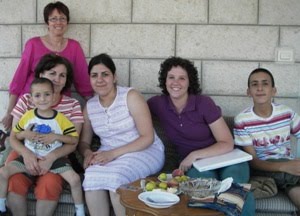
But even in this 62nd year of their suffering, the Palestinians welcome visitors to their land—visitors like me from the very country that is still betraying them with $2.55B in military aid to Israel to support their occupation. Photo: Iptysam and her family welcome me into their home in Beit Jala.

“Just as I have loved you, you also should love one another.” I have experienced this Christian love in the welcome I receive when I visit the Palestinians in Bethlehem—even the Muslims. A love that transcends the betrayal and the desertion they still experience—while US dollars buy more ammunition for the Israeli soldiers who arrest their sons marching in protest of the Wall.

How can this be? It is a mystery to me—like the resurrection that awaits at the end of this most holy week.

Gracious God, you command us to follow in your way of love. You sent your son to bring us your message of reconciliation and peace, knowing that your love would be returned with betrayal and desertion, even by those who called you teacher and friend. Give us courage to be agents of reconciliation today—to carry your love even to those places where we will be betrayed and deserted. Amen.

Sunday, March 28, 2010

Evening, Palm Sunday, 2010

Luke 19.28-40

“When he had come near Bethphage and Bethany, at the place called the Mount of Olives, he sent two of his disciples….” (Luke 19.29)

As we lifted palms in church and heard the familiar words of Jesus’ entry into Jerusalem and shouted “Hosanna!” we were reenacting, as many Christians have done through the centuries, the event that begins the holiest week in the Christian calendar. Each year, Christians from all over the world retrace Jesus’ steps, processing down the Mount of Olives and into the Old City of Jerusalem. Palestinian Christians from Bethlehem and the rest of the West Bank have participated in this procession for many years.

Even in Luke’s account, there are mixed reactions to Jesus and the adulation of the crowds. As they shout for joy and throw their cloaks on the path to welcome him, “some of the Pharisees” are worried and warn that this public acclamation should stop.

Not much has changed in the past two thousand years. The procession of palms in Jerusalem—Christians parading through the streets, praising God and marking this holiest of weeks, are still seen as a threat.

Although pilgrims from Ireland, the Philippines and Utah walked in the Jerusalem procession today, most Palestinians from the West Bank were denied entry into Jerusalem. In spite of the efforts of Palestinian church leaders who have been working with Israeli officials for weeks, no permits were given for their congregations to travel to Jerusalem, and Palestinians do not travel anywhere without permits. The five or so miles from Bethlehem to Jerusalem have become a divide that cannot be breached.

In Bethlehem today about 150 Palestinian Christians, with their Israeli and Muslim supporters, (along with two donkeys and a horse) did manage to get past the checkpoint. But they were quickly stopped by soldiers who piled out of their jeeps—beating and arresting the marchers. Eleven Palestinians were arrested at the main tourist checkpoint between Bethlehem and Jerusalem, the place our tour buses go through when we visit. (See photo with the palms and the soldiers arresting one of the marchers.) Four Israeli peace activists who were also detained were later released by the Israeli soldiers. See more photos: http://www.flickr.com/photos/activestills/ Read the story from Ma’an news agency: http://www.maannews.net/eng/ViewDetails.aspx?ID=272253 ; more details from Dr. Mazin Qumsiyeh’s blog: http://www.qumsiyeh.org/rightsblog2010/

Other Palestinians did manage to celebrate Palm Sunday at the Church of the Nativity in Bethlehem. And others walked with palms in the village of Al-Zababdeh near the West Bank town of Jenin (see AP wire photo at top).

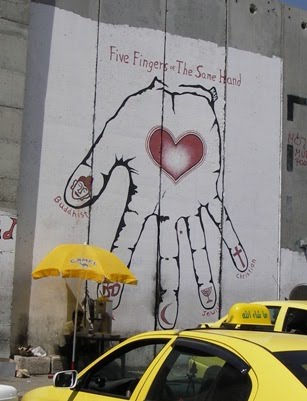
Even Jesus would not have been able to walk today from Bethany to Jerusalem. The Israeli security wall cuts off the main road, between Jericho and Jerusalem, the road that goes through Bethany. (photo shows where the wall blocks the Jericho road).

Today we marked Palm Sunday, not only with readings and reenactments of the procession, but also with the reading of the story of Jesus’ passion—the suffering he endured at the hands of the Roman empire, his arrest, the beating, the insults of the soldiers……….

Gracious God, you sent your son to show us your way of liberation and peace. Help us, who call ourselves by his name, to be messengers of peace and reconciliation in your world today. Help us break down the walls that divide us—to find one small thing we can do to bring reconciliation to the places where we live and work. Amen.

Wednesday, March 11, 2009

Women of UNconventional Wisdom

Lent 3, Sunday, March 15, 2009
John 2.13-22

If we want to know God, we must look to Jesus. Not to our priests or our rituals, not to our Bibles or even our potluck suppers. If we want to know God, we must look to see who Jesus is. This story in John’s gospel makes it very clear—God is the one who turns everything upside-down. He overturns all the rules, all the ways of doing “business as usual.” Jesus stands in civil disobedience to the ways of the world, against the conventional wisdom, the wisdom of the rulers and the powerful religious leaders.

And he calls us to follow him.

In Israel the conventional wisdom says, guard yourself against attack—build a wall to keep out suicide bombers; require travel permits for anyone who looks or acts suspicious; keep the dangerous people walled up inside their West Bank towns—like Bethlehem and Ramallah. Conventional wisdom says imprison people who you suspect might want to harm you—even if you can’t charge them with any particular crime. Just to be on the safe side, keep all Arab young men out of Jerusalem; you never know who might be a suicide bomber.

The women of Machsom Watch, however, are UNconventional….AND very wise. These Jewish grandmothers have had enough of war and weapons and the militarization of their grandchildren who are trained in Israel’s army to harass Palestinians at the checkpoints. The women of Machsom Watch are turning the tables on the checkpoint system. These 500 women show up at the checkpoints and watch what happens there. Then they write down everything they see and compile reports of the way Palestinians are treated as they try to leave Ramallah or Bethlehem or Qalquilya or any of the 50 checkpoints they monitor.

These Jewish grandmothers turn the tables on the system of checkpoints by stepping in to help in situations where Palestinians are being harassed—like the man who was returning home after surgery to remove his leg. He had entered Israel for his surgery with both legs attached to his body; he tried to leave with one of his legs in a bag—he was taking it home so that it could be buried and when he died the leg could be buried with him. But the soldier at the checkpoint held him there because the man had his own ID card, but he had no ID card for the leg and no permit to bring a leg through the checkpoint. For ten hours this man sat at the checkpoint while the soldiers summoned a doctor to look at the leg to verify that it was indeed his leg and that it had no explosives in it. And Hannah waited with him, determined to see his ordeal through to the end.

Hannah is one of the grandmothers of Machsom Watch. She told us this story and many others—stories of families trying to get their children to the hospital for cancer treatment, unable to get through the checkpoint because they did not have the proper papers—papers for the child, but not for the mother to go along; papers for the mother, but not for medical purposes; papers faxed to offices the family cannot get to because they are on the other side of a checkpoint.

Hannah has seen it all and she does her best to overturn the tables, to turn the rules upside down so that people’s needs are met—the hungry fed, the sick given medical care, the poor helped.

Watch a 3-minute video of the checkpoint in Bethlehem, made by one of the grandmothers of Machsom Watch. Every morning more than 2000 workers stand, pressed in the crowd, to get to work. American USAID money was used to “humanize” the checkpoint—money spent on decorative “welcome” banners, flowers and shrubbery, and twelve guard stations, only a couple of which are open each morning.

O God, your foolishness turns our worldly wisdom upside down. Give us courage to act in unconventional ways so that our rules do not impede your justice. Open our eyes to see those places where we confuse our need for safety and security with your will for your people. Amen.

Friday, March 6, 2009

Living Under the Cross - Shawan Jabarin

In the Occupied Territories, it is not only Christians who find themselves living under the cross. Shawan Jabarin, executive director of the Palestinian human rights organization al-Haq, has not been allowed to leave the West Bank since 2006, when he was appointed to this position. Between 1999 and 2006, he was permitted to leave eight times, but his petitions for permits have been denied since 2006, on the grounds that he is active in the Popular Front for the Liberation of Palestine. He was given no opportunity to confront these allegations, however, and he was never questioned about his activities.

Last month, along with the Israeli human rights organization B’Tselem, he was awarded the “Geuzen Resistance 1940-1945” prize. The prize will be awarded in ceremonies on March 13, but has been unable to gain permission to leave the West Bank to receive the prize.

Jabarin is not alone, however. He has many people helping him carry his cross—Israelis and Palestinians, including Rabbis for Human Rights, which has members in the US. They and nine other human rights organizations have written to the Defense Minister and to the Commnander of Military Forces in the West Bank, protesting the denial of freedom to Jabarin.

This happens every day in the Occupied Territories—both the denial of movement for Palestinians and the support from others on both sides of the separation wall. B’Tselem is an Israeli organization which monitors human rights abuses in Israel and the Occupied Palestinian Territories. Read more about Jabarin’s story on B’Tselem’s web site, as well as news about planned settlement expansion and the story of Adham Ghaneimat, 14, in his own words, the story of his beating by settlers last month as he walked with two friends on his family’s land near his village of Surif near Hebron in the West Bank, a few miles south of Bethlehem.

Find out what happens with Al-Haq's appeal for Jabarin's travel permit: http://www.alhaq.org/ The outcome of the hearing March 5 is posted here (the hearing was continued): http://www.alhaq.org/etemplate.php?id=434

Shawan Jabarin and Al-Haq are engaged in important work to combat human rights violations in the Occupied Territories. Because of his work he himself is in danger of imprisonment as well as living under the travel ban. Many human rights organizations have been working to support him and his work:

Thursday, March 5, 2009

Asil's Story

The story of Asil comes from Sam Bahour, a telecommunications executive in Ramallah. Asil's story shows the Palestinian dilemma. Note especially the comment at the end: the Palestinian Authority operates under diminished capacity because Israel is still withholding taxes collected from Palestinians but not released back to the Palestinian Authority, their punishment for the Hamas electoral victory.

The Death of Asil
written by Dr. Dudy Tzfati

With a heavy heart I write about Asil, a six year old girl from the Palestinian village of Wadi Fuqeen, near Bethlehem. Asil was sick with tuberculosis, which got complicated and reached the brain. She was referred to the Israeli Hadassah Hospital and her parents managed to get the needed financial coverage for day treatments from the Palestinian Ministry of Health. Two weeks ago she arrived to the hospital and underwent several tests. A CT scan was needed, but since it was not included in the coverage, Asil was released home without it.

Asil’s parents tried to get additional financial coverage for the CT scan and for full hospitalization, which was needed, but their efforts were in vain. The Palestinian Ministry of Health refused. Helplessly, they tried to get an urgent appointment for a CT scan in a Palestinian hospital, but the waiting line was too long.

A few days later, on a Friday, Asil’s condition deteriorated. She needed urgent hospitalization and treatment of her escalating brain infection. But since she did not have the coverage for hospitalization at Hadassah, she was taken to a hospital in Bethlehem, where they didn’t have the necessary medicine and expertise to treat her. Her parents continued to beg for approval of the financial coverage to send her back to Hadassah, with no success. By Sunday morning her situation worsened.

She still had the coverage for day treatments in Hadassah so the doctors wanted to send her there in an ambulance. However, when they called Hadassah, the Hospital management told them not to come, knowing that emergency room and full hospitalization would be required. Asil’s parents and the Israeli doctor caring for her in Hadassah begged the manager, with no success. Without upfront financial coverage, Asil was left in Bethlehem and started to take the medication advised by the Hadassah doctor. But this was too late and too little. On Sunday night Asil passed away.

How can we accept such an unbearable situation and denial of life-saving treatment, which was available by a 15 minute drive from Asil’s home? And Asil is not the only one. In Hadassah Pediatric Hemato-oncology department alone, the financial coverage for 57 kids was cut in the midst of their treatment – a death sentence for many of them. A physician friend is spending his time and own money to buy expensive medicine for the children he saved by performing bone marrow transplants, because their parents cannot cover the post- transplant expenses. Otherwise they would be lost.

Who knows how many more patients are dying because they have no access to life-saving treatments available in Israeli, but not in Palestinian, hospitals. Apparently, the Palestinian Authority recently decided to cut the financial coverage for transferring Palestinians for medical care in Israel, while the Palestinian Authority’s tax money continues to be illegally held by Israel.

The Israeli hospitals refuse to treat patients without financial coverage, and the Israeli government denies its responsibility for the Palestinians living under its control. Meanwhile, innocent children pay with their lives.

What can be done? Is there not enough suffering around? Can we demand from the Palestinian Authority to leave the children and sick out of the struggle? Can we demand from the Israeli government to assume responsibility for the Palestinians under its control? Or maybe we can all raise donations for this purpose?

Dr. Dudy Tzfati teaches Genetics at the Hebrew University of Jerusalem.
February 22, 2009